Rosedil ingredients and label
The Supplement Facts panel as text, the percentages re-derived, and a cautious reading of each of the eight lines.
Supplement Facts, typed out
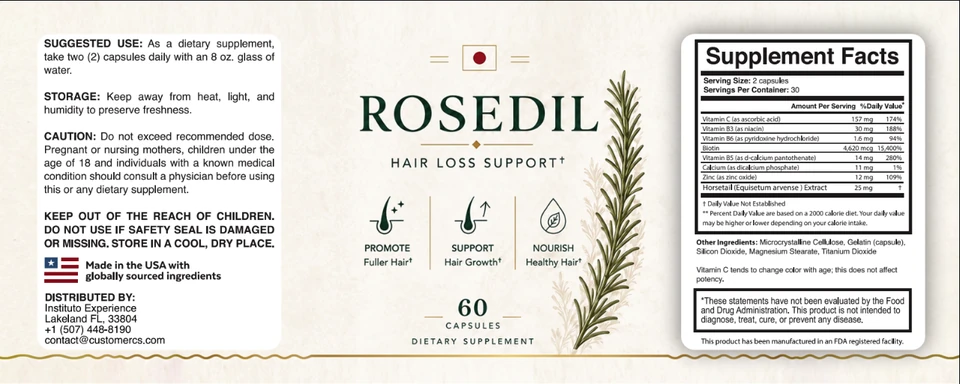
Below is the panel from the Rosedil label artwork, reproduced as text so that screen readers and small phones can use it. Amounts are per serving, and a serving is 2 capsules. The bottle contains 30 servings.
| Supplement Facts | Amount per serving | % Daily Value |
|---|---|---|
| Vitamin C (as ascorbic acid) | 157 mg | 174% |
| Vitamin B3 (as niacin) | 30 mg | 188% |
| Vitamin B6 (as pyridoxine hydrochloride) | 1.6 mg | 94% |
| Biotin | 4,620 mcg | 15,400% |
| Vitamin B5 (as d-calcium pantothenate) | 14 mg | 280% |
| Calcium (as dicalcium phosphate) | 11 mg | 1% |
| Zinc (as zinc oxide) | 12 mg | 109% |
| Horsetail (Equisetum arvense) Extract | 25 mg | † |
Checking the percentages
A percent Daily Value is simply the amount divided by a reference figure. We took the adult references from the FDA’s Daily Value list and redid the division for all seven lines that have one. Each answer rounds to what the label prints.
| Line | In two capsules | FDA Daily Value (adults) | Our division | Label prints |
|---|---|---|---|---|
| Vitamin C | 157 mg | 90 mg | 174.4% | 174% |
| Vitamin B3 | 30 mg | 16 mg | 187.5% | 188% |
| Vitamin B6 | 1.6 mg | 1.7 mg | 94.1% | 94% |
| Biotin | 4,620 mcg | 30 mcg | 15,400% | 15,400% |
| Vitamin B5 | 14 mg | 5 mg | 280% | 280% |
| Calcium | 11 mg | 1,300 mg | 0.8% | 1% |
| Zinc | 12 mg | 11 mg | 109.1% | 109% |
| Horsetail extract | 25 mg | None set | Nothing to divide by | † on the label |
Scroll the table sideways for the remaining columns.
The spread is wide. At one end, 4,620 mcg of biotin is 154 times its 30 mcg reference. At the other, 11 mg of calcium is 1% of a day’s reference, too little to count toward your calcium.
Line by line
Each ingredient gets three short answers: what the label commits to, what a mainstream reference says about the nutrient in general, and what remains unproven for these capsules in particular. No trial of the finished product has been published on the pages we read.
Biotin: 4,620 mcg
- On the label
- 4,620 mcg in two capsules, which is 15,400% of the Daily Value, or 2,310 mcg in each capsule.
- In general references
- MedlinePlus says biotin and pantothenic acid are needed for growth and help the body break down and use food. It sets adequate intake for adults at 30 mcg a day, names hair loss among the signs of deficiency, and reports no known toxic symptoms. Separately, the FDA cautions that biotin can interfere with certain lab tests.
- Not established
- Whether extra biotin changes anything for a person who already gets enough. The reference speaks about deficiency, and deficiency is the only situation it describes.
Zinc: 12 mg
- On the label
- 12 mg as zinc oxide, 109% of the Daily Value.
- In general references
- MedlinePlus describes zinc as present in cells throughout the body, with a part in cell division, cell growth and wound healing. Loss of hair is on its list of deficiency symptoms. It also warns that long-term excess intake can lead to copper, iron or magnesium deficiency.
- Not established
- A hair benefit for someone with normal zinc status. Count the zinc in everything you take and show a pharmacist the total.
Vitamin C: 157 mg
- On the label
- 157 mg as ascorbic acid, 174% of the Daily Value. A label note says vitamin C tends to change color with age without losing potency.
- In general references
- MedlinePlus says vitamin C is needed for the growth and repair of tissues and is used to form collagen, a protein in skin, tendons, ligaments and blood vessels. Dry and splitting hair is one of the deficiency signs it lists, and it does not recommend amounts greater than 2,000 mg a day.
- Not established
- That a serving of Rosedil improves hair in a person who eats fruit and vegetables. The deficiency sign is not a promise in reverse.
Vitamin B3: 30 mg
- On the label
- 30 mg as niacin, 188% of the Daily Value.
- In general references
- The adult Daily Value on the FDA list is 16 mg, so the percentage on the label is right. We cite nothing further for this line.
- Not established
- Any role in hair. The label says “niacin” without naming the chemical form, and the brand’s page offers a description we could not match to the references used here, so it is left out.
Vitamin B5: 14 mg
- On the label
- 14 mg as d-calcium pantothenate, 280% of the Daily Value.
- In general references
- MedlinePlus groups pantothenic acid with biotin as vitamins needed for growth and for using food, gives 5 mg a day as adequate from age 14, and says large doses cause no symptoms apart from possible diarrhea.
- Not established
- A particular effect on hair. The reference stays with metabolism.
Vitamin B6: 1.6 mg
- On the label
- 1.6 mg as pyridoxine hydrochloride, 94% of the Daily Value.
- In general references
- The label reference for adults is 1.7 mg. This is the one vitamin in the formula kept just below a full day.
- Not established
- Everything else. The brand’s page does not discuss vitamin B6 and we have no hair-related statement to pass on.
Calcium: 11 mg
- On the label
- 11 mg as dicalcium phosphate, 1% of the Daily Value.
- In general references
- Against a Daily Value of 1,300 mg this is a trace. The label does not say why it is included.
- Not established
- Any contribution to calcium intake worth counting.
Horsetail extract: 25 mg
- On the label
- 25 mg of horsetail (Equisetum arvense) extract. The dagger beside it stands for “Daily Value not established”.
- In general references
- None cited. The label gives no standardization and no extract ratio, which are the two details needed to compare one horsetail extract with another.
- Not established
- What a serving delivers in terms of any specific plant compound, and what 25 mg of it does. The brand mentions horsetail only in its FAQ.
What the capsule itself is made of
Under the panel sit 5 other ingredients: microcrystalline cellulose, gelatin (capsule), silicon dioxide, magnesium stearate, titanium dioxide. The FDA’s supplement Q&A explains that anything not declared in the Supplement Facts panel has to appear in this list, and gives gelatin as a typical example.
In capsules of this type, cellulose is ordinarily the filler, gelatin the shell, silicon dioxide and magnesium stearate the flow agents and titanium dioxide a white colorant. The gelatin rules the product out for vegetarians and vegans. There is no allergen statement on the label; for allergy questions write to [email protected] before you buy.
Five habits for reading this label
- Read amounts as “per two capsules”. The serving size is 2, so one capsule is half of every figure.
- Total your zinc, niacin, vitamin C and biotin across all supplements. Rosedil alone gives 12 mg, 30 mg, 157 mg and 4,620 mcg.
- Before a blood test, say that you take 4,620 mcg of biotin daily.
- On arrival, look at the safety seal and the expiry date before opening.
- If your bottle’s panel is different from this page, go by the bottle and let us know at [email protected].
Storage and caution in the label’s words
Storage: keep away from heat, light and humidity to preserve freshness. Store in a cool, dry place.
Caution: do not exceed recommended dose. Pregnant or nursing mothers, children under the age of 18 and individuals with a known medical condition should consult a physician before using this or any dietary supplement. Keep out of the reach of children. Do not use if safety seal is damaged or missing.
Where this page gets its facts
- The product: Rosedil’s label artwork and brand page, the Rosedil order page, the seller’s returns and contact pages and the BuyGoods checkout, all read on November 27, 2026.
- Background reading: U.S. Food and Drug Administration. Daily Value on the Nutrition and Supplement Facts Labels.
- Background reading: MedlinePlus Medical Encyclopedia. Pantothenic acid and biotin.
- Background reading: U.S. Food and Drug Administration. Biotin Interference with Troponin Lab Tests.
- Background reading: MedlinePlus Medical Encyclopedia. Zinc in diet.
- Background reading: MedlinePlus Medical Encyclopedia. Vitamin C.
- Background reading: U.S. Food and Drug Administration. Questions and Answers on Dietary Supplements.
- Worked out here: pack totals, cost per day and per capsule, the Daily Value checks, the guarantee calendar and every pack-to-pack comparison are our own arithmetic on the label and the prices above.