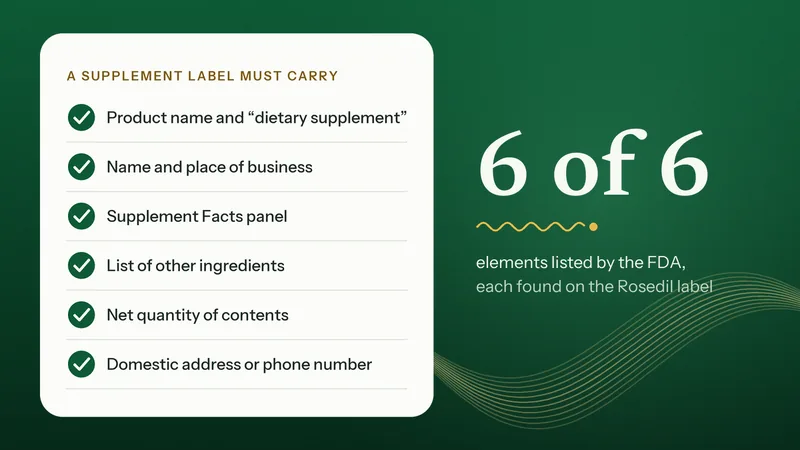
Most of what you can know about a supplement before buying it is printed on the bottle, and what must be printed there is set by regulation. The FDA’s questions and answers on dietary supplements lists the required elements. We took that list to the Rosedil label and looked for each one.
Six required elements, six found
| The FDA says a label must bear | On the Rosedil label | Where |
|---|---|---|
| A product name and the words “dietary supplement” | “Rosedil” and “Dietary Supplement” | Front panel |
| The name and place of business of the manufacturer, packer or distributor | “Distributed by: Instituto Experience, Lakeland FL, 33804” | Left panel |
| A Supplement Facts panel with serving size, servings per container and each ingredient’s amount | Serving size 2 capsules, 30 servings, 8 lines with amounts | Right panel |
| A list of other ingredients not declared in the panel | Microcrystalline cellulose, gelatin (capsule), silicon dioxide, magnesium stearate, titanium dioxide | Under the panel |
| The net quantity of contents | “60 capsules” | Front panel |
| A domestic address or phone number for reporting serious adverse events | +1 (507) 448-8190 and the Lakeland FL, 33804 address | Left panel |
Scroll the table sideways for the remaining columns.
All 6 are present. That is a low bar, since it is what the law asks of every supplement, but it is a bar worth checking, and it tells you where to look on any other bottle in your cupboard.
Two lines the label adds by choice
“Made in the USA with globally sourced ingredients”
This is an origin statement. Read literally, it says the product is made in the United States and that its ingredients may come from anywhere. It does not name the factory. The company on the label is the distributor, and a distributor need not be the manufacturer.
“This product has been manufactured in an FDA registered facility”
Registration is easy to misread as a seal of quality. The same FDA page explains that facilities which manufacture, process, pack or hold dietary supplements for consumption in the United States must register with the agency. It is a duty of the facility, not a verdict on the product.
The page is equally direct about what the FDA does not do: it has no authority to approve dietary supplements before they are marketed, and it does not test them before they are sold. A registered facility and an approved product are different things, and only the first applies here.
The small symbols
Rosedil’s front panel puts a dagger after “Hair Loss Support” and after each of its three statements. A symbol like that is there because of a rule the FDA page also covers: when a label makes a structure and function claim, the law requires a disclaimer saying the FDA has not evaluated it and that the product is not intended to diagnose, treat, cure or prevent any disease.
On this artwork the symbols do not quite line up. The disclaimer box is introduced by an asterisk, while the dagger’s own footnote, inside the Supplement Facts panel, reads “Daily Value Not Established” and belongs to the horsetail line. The disclaimer is there and it is the correct one; a reader simply has to connect the front-panel daggers to it without the symbol’s help.
What no label has to tell you
- Who manufactured the product, if a distributor is named instead.
- Whether an independent laboratory tested the batch.
- What a plant extract is standardized to. Rosedil’s panel gives 25 mg of horsetail extract and nothing more about it.
- Why each ingredient was chosen, or what evidence the company holds for its statements.
The FDA’s own advice for these gaps is to contact the manufacturer or distributor directly. For Rosedil that means [email protected].
A percent you can verify yourself
The panel is the one place where a label can be checked with a calculator. Take any line, divide the amount by the adult reference on the FDA’s Daily Value list, and compare. For zinc, 12 mg over 11 mg is 109.1%, and the label prints 109%. For vitamin C, 157 mg over 90 mg is 174.4%, printed as 174%. All seven percentages on the Rosedil panel pass this test.
Carry this checklist to any bottle
- Is it called a dietary supplement on the front?
- Is a company named, with a city and a way to reach it inside the United States?
- Does the Supplement Facts panel state a serving size and the servings per container?
- Does every ingredient have its own amount, or are some hidden inside a blend?
- Is there an other-ingredients line, and does it contain anything you avoid?
- Is the FDA disclaimer present wherever a body-related claim is made?
- Do the percentages survive your own division?
Where this page gets its facts
- The product: Rosedil’s label artwork and brand page, the Rosedil order page, the seller’s returns and contact pages and the BuyGoods checkout, all read on November 27, 2026.
- Background reading: U.S. Food and Drug Administration. Questions and Answers on Dietary Supplements.
- Background reading: U.S. Food and Drug Administration. Daily Value on the Nutrition and Supplement Facts Labels.
- Worked out here: pack totals, cost per day and per capsule, the Daily Value checks, the guarantee calendar and every pack-to-pack comparison are our own arithmetic on the label and the prices above.